
Promoting sustainable fair, and accessible mobility
València has been working for decades on promoting a model of sustainable, accessible, and fair mobility. To achieve this, mobility is addressed in a global and systemic manner, considering the current situation, needs, and the areas for improvement that can have the most positive impact, without causing unwanted negative consequences. In this regard, three main lines of action stand out: pedestrian mobility, cycling mobility, and public transport mobility.

Why is it an emblematic project?
The different lines of action described aim to encompass and improve the coexistence of all forms of mobility in the city while promoting the rational use of private vehicles.
Their transformative potential is very high, as they not only seek to reduce the environmental impact of transport but also improve urban quality of life and address the accessibility and safety needs of citizens, promoting significant changes in the use of public spaces and resources.
For example, pedestrian mobility promotion projects not only have the potential to reduce the use of private vehicles but also ensure that people of all ages and abilities can move safely. These projects reduce the risk of accidents and foster more walkable, community-friendly environments.
Cycling mobility promotion projects, like those for pedestrians, also have a clear impact on improving public health by encouraging more active modes of transport. At the same time, they provide safety for all types of users and ensure harmonious coexistence between the various vehicles in the city.
On the other hand, projects focused on sensor technology, energy efficiency, or the creation of low emission zones not only have a clear impact on reducing energy consumption and fossil fuel use, but they also increase the city's intelligence and enable more efficient, connected management.
Contracts, tender documents, by-laws
- Low Emission Zone (ZBE) Ordinance: In the approval phase.
- Bus Stop Accessibility Contract https://contrataciondelestado.es/wps/portal/!ut/p/b0/04_Sj9CPykssy0xPLMnMz0vMAfIjU1JTC3Iy87KtUlJLEnNyUuNzMpMzSxKTgQr0w_
- Example of a Bike Lane Construction Contract https://contrataciondelestado.es/wps/portal/!ut/p/b0/DcoxCoAwDADA1zhHBxfBoYhu4ljbRUIbJBiraOz77Xhw4GEFnzDzjspXQil2kegWTk
- ZBE https://contrataciondelestado.es/wps/portal/!ut/p/b0/04_Sj9CPykssy0xPLMnMz0vMAfIjU1JTC3Iy87KtUlJLEnNyUuNzMpMzSxKTgQr0w_
Areas and other stakeholder involved
- EMT València
- City Council, Mobility and Public Safety
- Smart City València
- Contracted Companies
Budget
- Contract for bus stop accessibility: €1.9 million (NGEN)
- Bike lanes: €600,000 km approx. (NGEN)
- BRT (Bus Rapid Transit): €2.6 million (NGEN)
- Low Emission Zones (LEZ): €8.9 million (NGEN)
- The rest of the actions are included within the mobility service maintenance contracts
Lessons learned and recommendations
- A global vision of mobility: Public space is shared and limited, and mobility is a complex system. If isolated solutions are proposed to improve mobility for specific users without considering the system as a whole, the effectiveness of the measures may be lost, or dysfunctions can arise. Therefore, it is necessary to adopt a global vision of mobility that integrates public transport, private transport, urban logistics, as well as cycling and pedestrian mobility. In this regard, the City Council of València works on all aspects of mobility, paying particular attention to vulnerable users.
- Road safety: To promote a shift towards more sustainable modes and the rational use of private vehicles, the role of road infrastructure is essential. Furthermore, with the emergence of new forms of mobility (e.g., Personal Mobility Vehicles or PMVs), it is crucial to ensure that both new and existing infrastructure provides safe conditions for all users, especially the most vulnerable. The City Council of València systematically conducts road safety audits at the city's most conflict-prone points to analyze user behavior and the characteristics of the infrastructure, with the aim of proposing improvements.
- Technology as an ally: Thanks to mobile applications, citizens and businesses can access more information about mobility, which can lead to reduced traffic congestion or greater use of sustainable modes such as public bicycles or public transport. The City Council of València has made a significant effort to equip a large portion of taxi, PMR (accessible), and loading/unloading spaces with sensors, providing users with real-time occupancy information.
- Road safety education and awareness are essential: Road safety education and the promotion of a culture of sustainable mobility are key elements in achieving this goal. The City Council of València runs ongoing road safety campaigns in coordination with the local police, both in schools and through street-level awareness campaigns. The European Mobility Week framework is also leveraged to reinforce the message of promoting sustainable mobility habits.
- Recovery of mobility after the DANA: the serious damage caused by the floods of 2024 has prompted emergency measures, coordinated between different administrations, to allow the connection and mobility between the affected areas and other municipalities and neighbourhoods of València and its metropolitan area to be recovered as soon as possible.
Impact KPI'S
- Accessible bus stops
- Safe school routes
- Square meters of safe school environments
- Kilometres of residential streets
- Kilometres of bike lanes
- Kilometres of cycle streets
- Kilometres of bus lanes
- % of sensor equipped PMR, taxi, loading/unloading spaces
- % of crossings with traffic light countdowns
Timeline
2024 First cycling neighbourhood in Russafa
2024 Accessibility improvements at 740 bus stops
2024 66 km of segregated bus lanes
2024 2,000 additional sensors for PMR and loading/unloading spaces
2025 Bus Rapid Transit (BRT) on Blasco Ibáñez Avenue
2025 15 new km of bike lanes
2028 47% of crossings with traffic light countdowns
Lathi (FIN)
“The European Green Capital Award took Lahti to a whole new league of environmental players. An international recognition like this has brought a lot of environmental activities and investments to the city as well as pride to our citizens. We are very committed to going forward as a leading environmental city.”
Mayor Mr. Niko Kyynäräinen
Lahti Gem
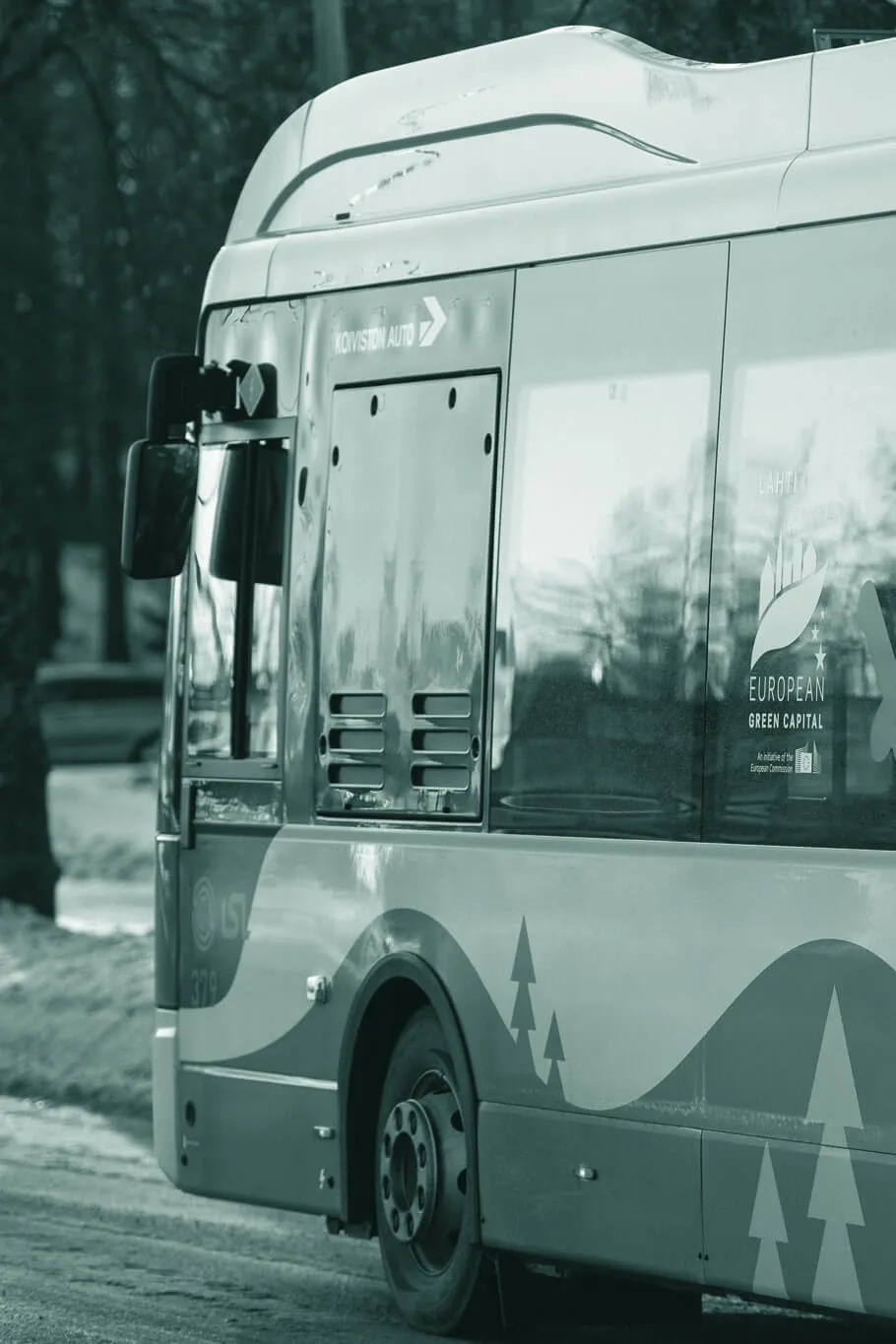
Lahti GEM –Green Electrification of Mobility Cluster– is a platform for companies, research, and education organisations as well as cities. The platform is established to generate and maintain cooperation for developing and commercialising technologies and solutions for the cleaner future of mobility. The European Green Capital year 2021 in Lahti mobilised the cluster development.
Top priorities of the cluster are the creation of solutions for electrification of heavy-duty transport and machines, developing and establishing charging and refuelling infrastructure for alternative fuels, and enhancing activities in carbon-neutral energy system development. Automation and digitalisation as well as data analytics play crucial roles as cross-cutting priorities. All transport modes are covered.
Lahti GEM's activities are open to all actors involved in the electrification of transport or who are interested in building the future of emission-free transport. There are more than 40 companies involved in the cluster already.
Lessons learned and recommendations
A rapid technological breakthrough is underway in electrified traffic. Tightening regulation and consumers' concern about climate change are generating a rapid change in traffic. The popularity of electric cars is growing, but many people do not know that electric transport is not only electric cars and batteries. It is also a change in the entire energy production and infrastructure.
Lesson to learn is also how city van work as a platform for development. Bringing companies and research to the same arena is the key.
Budget
Some projects linked with the theme and project coordinator. Companies have gathered development funding for their products and ideas.
Links with more information
Cycling infrastructure and development of the public transport development.
Sustainable mobility for rural municipalities has been improved, thanks to the work and collaboration with other municipalities.
The Charging Infrastructure Strategy's goal is to coordinate the work of all relevant actors in developing an appropriate network of public charging stations throughout the municipality.
Bike to Work, using an app to track home-to-work commutes made with slow mobility means by residents of 18 municipalities, has promoted, through the allocation of over €100k in shopping vouchers, a reduction in pollution, leading to a savings of 80,907 kg of CO2, equivalent to 4,045 trees.
Transformation of Avinguda dels Alps into a green and peaceful corridor of more than 1 km, with reduction of 2 traffic lanes, a cycle lane and new areas with trees and shrubs. The sidewalks have been widened and new raised pedestrian crossings.
More bike lanes: As part of Nyborg's climate action plan, we want to promote CO2-neutral mobility. Therefore, Nyborg has expanded the municipality's infrastructure with 14 km of bike lanes and launched a “borrow a free e-bike” campaign.
Cap i peus: At Sustainable Mobility Week'24, citizen science pilot project will be launched: An App developed by Academia (UPC) & citizen volunteers. Goals: to collect data to improve the app algorithms & find out citizens mobility habits to make better decisions.
The new Urban and Sustainable Mobility Plan has recently been approved. The plan updates the previous Urban Mobility Plan and sets out measures (such as new pedestrian zones, improvements to public transport or a vehicle fleet study) for the next 6 years.
Liepāja has developed an extensive network of over 63 km of bicycle paths, continuously expanding with each street reconstruction project.
Green and socially responsible city logistics innovations SPOTLOG project.
ToMove is a Living Lab spread throughout the city and focused on the development of new smart and sustainable urban mobility scenarios, which use innovative cooperative, connected and autonomous mobility solutions, integrating them into the “Mobility as a Service” paradigm.
“Mobility without Footprint” project educates local schools on sustainable mobility. It covers public transport, cycling, and accessibility, leading to co-created school mobility and accessibility plans for a safer home-school journey.