Mouth Park of the Old River Turia
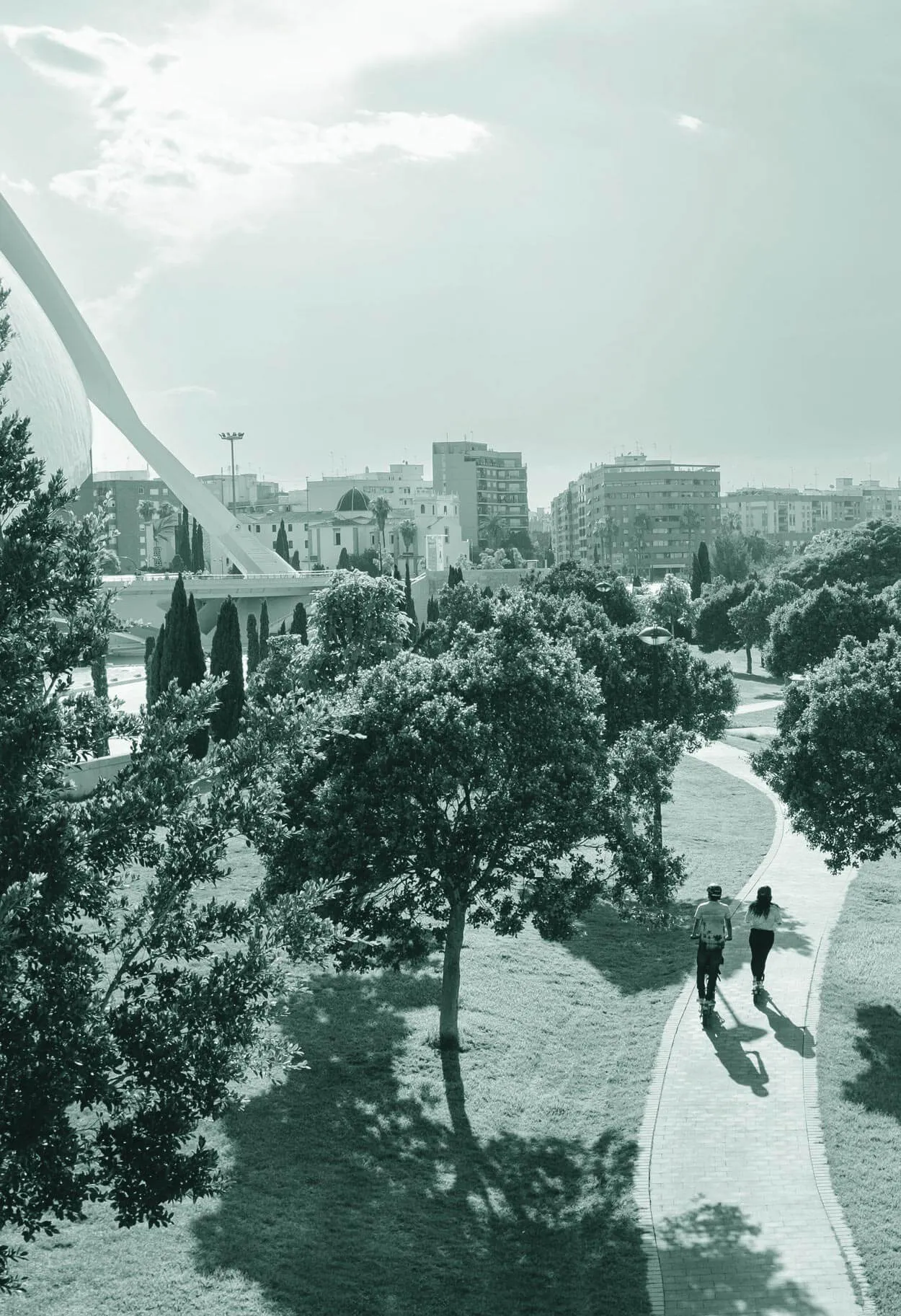
The Turia Gardens is the largest linear park in Europe and one of the most prominent symbols of the city's urban transformation. It was conceived as a solution to the problems caused by the frequent floods of the Turia River, which in 1957 led to a catastrophe that inundated the city and caused the deaths of many people. Following this event, it was decided to divert the riverbed south of the city, leaving a vast empty space that, after many debates and protests from residents, was converted into a park instead of being used for a motorway, as had originally been planned.
Why is it an emblematic project?
Nowadays, the Turia Gardens are essential for the quality of life and the protection of the people of València. It is not only a place for recreation and sports but also hosts cultural events and festivals, becoming a key point in the city’s social calendar. Its varied design, which includes landscaped areas, sports facilities, and natural spaces, has established it as a model for the reuse of urban spaces.
This project marks the completion of the Turia Gardens, which begin at the Cabecera Park and will end with this development at the river’s mouth. This project represents the main urban park of the city of València, with an importance that extends beyond the city itself, as it is one of the best parks in Europe. Additionally, it signifies the regeneration of a degraded area and provides an essential connection between the city and the sea.
Areas and other stakeholders involved
This is a cross-cutting project in which the following services play an important role:
- Urban Planning Department
- Parks and Gardens Department
- Water Cycle Department
- Port of València
Budget
16.723.453,61 €
Lessons learned and recommendations
- The Importance of Neighbourhood Movements: The “The River is Ours and We Want It Green” movement demonstrated the power of citizen participation in influencing urban planning decisions, pushing for the transformation of the river into a green space instead of a highway.
- The importance of studying and implementing infrastructures to protect against extreme meteorological events, such as the example of the new river channel that was created after the 1957 flood and has played a crucial role in the 2024 DANA.
- Long-Term, Phased Planning: The Turia Garden was developed in multiple stages, allowing each section to be completed and used while the rest of the park was still under construction. This flexibility enabled adjustments and adaptations as the project progressed.
- Reutilisation of Disused Spaces: Cities should identify underused areas such as riverbeds, industrial zones, or vacant land, and find ways to revitalise them into green spaces or public areas. This approach not only improves urban spaces but also contributes to environmental sustainability.
- Creating a Multifunctional Green Corridor: Designing spaces that combine recreational, cultural, sporting, and environmental activities ensures their use by a variety of groups and encourages interaction among different segments of the population, making the space more inclusive and engaging for all.
Impact KPI'S
- Project Approval
- Awarding of the Construction Contract
- Commencement of Works
- Completion of Works
Timeline
1957 Major Flood of València (Gran Riada de València)
1961 Diversion of the Turia River's course
1986 Inauguration of the first sections of the park
1998 Inauguration of the City of Arts and Sciences (Ciudad de las Artes y las Ciencias)
2004 Inauguration of the Cabecera Park (Parque de Cabecera)
2007 Opening of the Bioparc
2015 Complete connection of the park
2024 Awarding of the project design for the Mouth of the River Park (Parque de Desembocadura)
2024 Floods caused by the DANA on October 29th
2025 Awarding of the contract for the execution of works
2027 Completion of the works
Pinqua is a project for the regeneration of an entire densely populated neighbourhood with the presence of at-risk groups. The intervention focuses on the structural, seismic and energy redevelopment of buildings and also on the common spaces of the neighbourhood.
Our Vision for Housing 2020-2025 offers a powerful integrated vision for housing, that contains plans to make the housing, working and living environment attractive.
The Municipality of Elsinore was interested in the effects of imposing sustainability requirements when soliciting tenders for municipal land. An example of sustainability being the decisive factor when selecting a buyer, rather than the highest bidder.
Floating building: 1st building of a new campus that harmonises economic activity and natural landscape, restoring biodiversity of the delta territory. Its bioclimatic design optimises natural resources & integrates generation and efficiency systems, aiming for net energy balance and minimal environmental impact.
The Strategic Environmental Assessment (SEA) evaluates and ensures the incorporation of environmental aspects into the formulation of the municipal urban planning framework. The SEA proposes preventive and corrective measures, with a key focus on the naturalisation of urban spaces.
Urban planning in Nyborg is based on a plan with four strategic approaches to further develop the central parts of the city to ensure quality in the new and old urban areas and allow space for the green and blue wedges that characterise the municipality by the sea.
Climate tools for the city structure planning. The goal of the Lappeenranta urban planning project is to test and develop climate and energy impact assessment tools and methods in the assessment of the effects of master plans. Implementation in both general and site plans.
Energy-Efficient Public Building at Peldu Street 5. The municipal building in Liepāja was awarded as the most energy-efficient public building in Latvia for 2021.
Climaborough is a project designed to field test the ClimHub, Climate Sandbox and Climate Service concepts within 12 European Cities. It aims to enhance traditional urban and spatial planning approaches through data and knowledge-based decision making.
District C – Creative hub for zero-carbon: Our unesco World Heritage site promotes climate justice with green initiatives, Citizens' Assemblies, and Placemaking. It reduces emissions in energy, mobility, waste, and land use. A Green Belt boosts biodiversity, capturing 23.97 tons of CO2 by 2030.